A count, and what it changes
Jelly Force: Five Named On The Page, Nine On The Panel
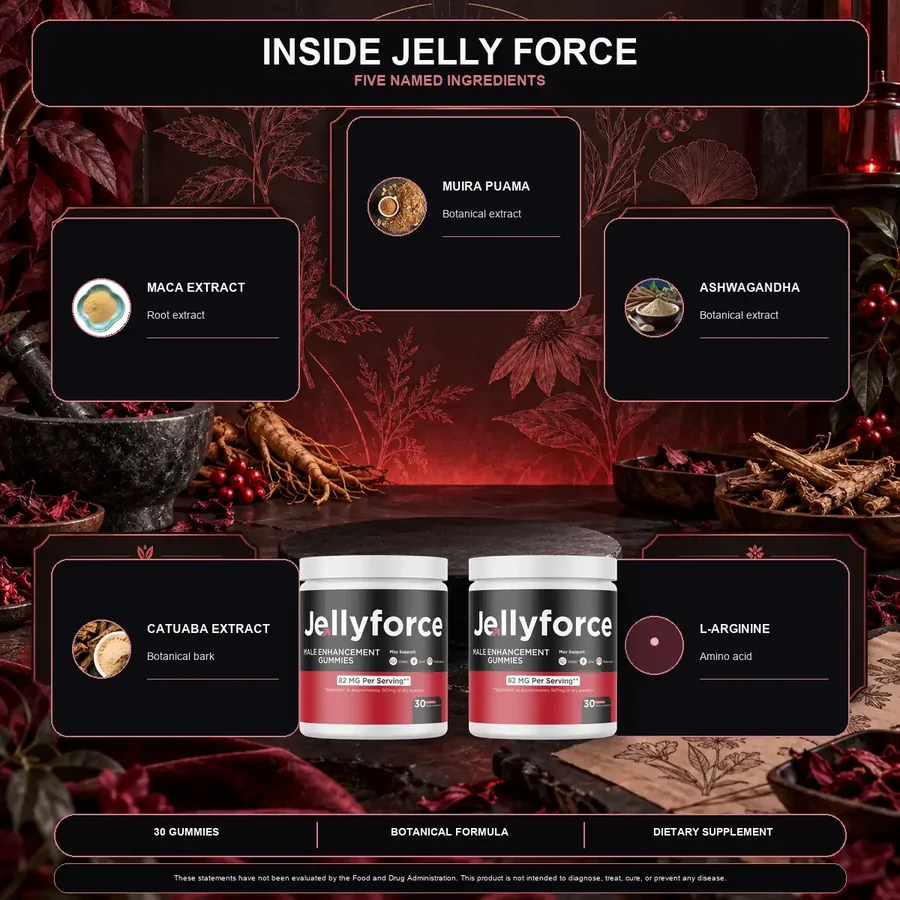
The Jelly Force sales page names five ingredients. The printed Supplement Facts panel names nine inside one 82 mg blend. The four the page leaves out are green tea extract, caffeine at 5 mg, tribulus terrestris and horny goat weed extract. All four are on the bottle, in printed order, and each one matters to somebody.
Five on the page, nine on the bottle
Count them yourself and the gap appears in about twenty seconds. The sales page lists muira puama, maca, catuaba, ashwagandha and L-arginine. The printed panel lists those five plus four more, all inside a single Proprietary Blend line weighing 82 mg.
Nothing here is hidden in the legal sense. All nine are printed on the bottle you receive, in order of weight, as the labeling rules require. The gap is between the advertising and the label, and it only exists for a reader who takes the advertising as the full list.
| Printed order | Ingredient | Named on the sales page? | Amount printed |
|---|---|---|---|
| 1 | Muira Puama | Yes | Not printed |
| 2 | Maca Extract | Yes | Not printed |
| 3 | Catuaba Extract | Yes | Not printed |
| 4 | Green Tea Extract | No | Not printed |
| 5 | Caffeine | No | 5 mg |
| 6 | Ashwagandha | Yes | Not printed |
| 7 | L-Arginine | Yes | Not printed |
| 8 | Tribulus Terrestris | No | Not printed |
| 9 | Horny Goat Weed Extract | No | Not printed |
The rows marked No are the story. The ingredients page takes all nine in turn.
What the five are, in one paragraph each
They are a reasonable five to choose. Four are plants people in this aisle recognize and the fifth has the strongest human evidence.
Muira puama is an Amazonian bark, first in the printed order, which by labeling rule makes it the heaviest of the nine. Maca is a Peruvian root eaten as a food crop, and the better-studied of the plants here: a systematic review of four randomized trials found limited evidence for sexual function and said the trials were too few and too small for firm conclusions (Shin et al., 2010). Catuaba is a market name rather than a species, covering several unrelated Brazilian plants, so the label cannot be matched to any particular study. Ashwagandha is the most researched plant in the bottle, with real safety notes attached (NCCIH). L-arginine is an amino acid and the one ingredient in the whole category with reproducible human results, at trial doses of 2 to 20 grams a day (NIH ODS).
None of the five carries an amount. Whatever each is doing, it does it inside 82 mg shared nine ways.
The four the page leaves out, and who each one matters to
None of the four is alarming and all four are common supplement ingredients. What changes is the list a buyer thought he was getting.
Green tea extract, fourth in the order
Fourth means it outweighs the ashwagandha and the arginine below it. Green tea extract is a normal supplement ingredient and also a caffeine source, which makes it two omissions in one. High-dose green tea extract has been linked to rare cases of liver injury (LiverTox, NIH), and the amount here is not published. Who it matters to: anyone avoiding stimulants, and anyone watching their liver because of a condition, a medicine or a doctor’s instruction. Those are the readers a short list fails.
Caffeine, 5 mg, fifth in the order
The only ingredient inside the blend with its own number, and the number is small. The FDA points to 400 mg a day as the level not generally tied to problems in healthy adults and gives a cup of coffee as roughly 95 mg (FDA), so 5 mg is about a twentieth of a cup. Who it matters to: anyone off caffeine on medical advice. The amount is trivial and the omission is not, because nobody can decide about an ingredient he was not told about.
Tribulus terrestris, eighth in the order
The most interesting omission, because tribulus is usually a selling point. It has been sold for decades on a testosterone story. A controlled study in young men was titled, and concluded, that the aphrodisiac herb tribulus terrestris does not influence androgen production (Neychev and Mitev, 2005). Who it matters to: anyone who has met that testosterone story elsewhere and would like to know a study did not back it.
Horny goat weed extract, ninth and last
Last in the order means the smallest share of the 82 mg. It is a traditional tonic and aphrodisiac whose active flavonoid is icariin, and NIH’s LiverTox rates it unlikely to cause clinically apparent liver injury (LiverTox, NIH). No icariin figure is printed. Who it matters to: the reader who would like the list to be the list. Its name is also the most recognizable in this category, which makes leaving it off a choice worth noticing.
Is a gap like this against the rules?
No. The rules govern the label, and the label is complete. Marketing copy is not required to repeat every ingredient, and a proprietary blend is a permitted way to publish one total weight with the names underneath, heaviest first (FDA labeling guide).
Five named, or nine?
The sales page names five ingredients: muira puama, maca, catuaba, ashwagandha and L-arginine.
The printed panel names nine inside the blend. The four the page leaves out are green tea extract, caffeine at 5 mg, tribulus terrestris and horny goat weed extract.
So this is not a compliance story. It is a trust story. A seller who names five of nine is not lying, and a buyer who reads the five and stops is not careless. The fix is one sentence: the panel wins, so read the panel.
Why the printed order is worth more than it looks
Because blend parts are listed heaviest first, the order is real information even with no amount given.
Caffeine is fifth and printed at 5 mg. So green tea extract, catuaba, maca and muira puama each weigh at least 5 mg, and ashwagandha, L-arginine, tribulus and horny goat weed each weigh 5 mg or less. One printed figure sets a limit on four ingredients below it, which is the most a reader gets out of a blend line.
- All nine names, which is what the panel is for
- The order by weight, which is a labeling rule rather than a design choice
- A 5 mg ceiling on the four ingredients printed below the caffeine
- The label's own fuller description of the blend, about 567 mg of dry powders
What it still cannot tell you is any single amount, or whether anything in the bottle reaches a researched dose. Our post on what 82 mg buys you does that arithmetic.
What to do with this: read your own bottle
That is the whole instruction, and it takes a minute. Advertising is a summary written to sell. The panel is a required document printed on the thing you paid for.
Turn your bottle around and find the blend line
It will print one weight and then a run of names separated by commas. That run is the full list.
Count the names, then count the ones the advertising gave you
If the counts differ, the panel is right. Write down the extras.
Check the extras against your own situation
Stimulants, liver, medicines, allergies. Four names take two minutes on a federal health site.
Tell your doctor or pharmacist the full list
Not the five, all nine. Ashwagandha alone interacts with sedatives, thyroid, diabetes, blood pressure and immunosuppressant medicines (NCCIH).
Do that on any bottle here and the marketing stops being what you buy from. The gummy label guide walks the rest of the panel, and the side effects page names the interactions in full.
The five and the nine: common questions
How many ingredients does Jelly Force actually have?
Nine, on the printed panel, all inside one proprietary blend weighing 82 mg. The sales page names five.
Which four ingredients are missing from the sales page?
Green tea extract, caffeine at 5 mg, tribulus terrestris and horny goat weed extract. All four are printed on the panel.
Does the gap mean the product is mislabeled?
No. The label is complete and lists all nine. The gap is between the advertising copy and the printed panel.
Why would a seller leave horny goat weed off the list?
Nothing in the source material explains the choice, so this site does not guess. It is printed on the panel, not on the page, and sits ninth of nine by weight.
Does tribulus raise testosterone?
A controlled study in young men found that it does not influence androgen production. That is the study most often cited on the question, and it does not support the testosterone claim the ingredient is usually sold on.
Should the caffeine worry me?
At 5 mg, roughly a twentieth of a cup of coffee, most people notice nothing. It is worth knowing if you avoid stimulants, and the green tea extract above it is a second caffeine source with no published amount.
How do I check my own bottle?
Find the Proprietary Blend line and read every name after the weight. That list is the full one. If it does not match the panel on our Supplement Facts page, call the order desk with your lot number.
Sources for this page
- Shin BC, Lee MS, Yang EJ, Lim HS, Ernst E. Maca (L. meyenii) for improving sexual function: a systematic review. BMC Complementary and Alternative Medicine, 2010. Source
- National Center for Complementary and Integrative Health. Ashwagandha: Usefulness and Safety. Source
- NIH Office of Dietary Supplements. Dietary Supplements for Exercise and Athletic Performance: Fact Sheet for Health Professionals. Source
- LiverTox: Clinical and Research Information on Drug-Induced Liver Injury. Green Tea. National Institute of Diabetes and Digestive and Kidney Diseases. Source
- U.S. Food and Drug Administration. Spilling the Beans: How Much Caffeine is Too Much? Source
- Neychev VK, Mitev VI. The aphrodisiac herb Tribulus terrestris does not influence the androgen production in young men. Journal of Ethnopharmacology, 2005. Source
- LiverTox: Clinical and Research Information on Drug-Induced Liver Injury. Horny Goat Weed. National Institute of Diabetes and Digestive and Kidney Diseases. Source
- U.S. Food and Drug Administration. Dietary Supplement Labeling Guide: Chapter IV. Nutrition Labeling. Source
Keep reading
Ready when you are
Order Jelly Force from the U.S. retail desk
One gummy a day. Follow the label on your bottle. 60-day money-back guarantee. A real person at +1 (302) 200-3480 for orders, tracking and refunds.