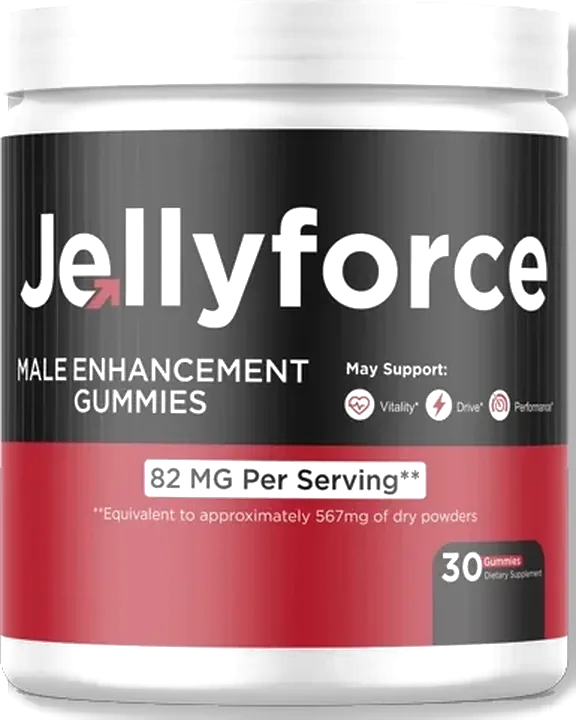
Mechanism, read against the printed panel
How Does Jelly Force Work? Each Ingredient's Role
Jelly Force works through its nine ingredients, which share one 82 mg blend.
Seven are botanicals with traditional use, one is the amino acid L-arginine, with human trials at gram doses, and one is 5 mg of caffeine.
Learn how to take it.
How does Jelly Force work?
Honestly, no one can tell you how this gummy works, because the gummy has never been studied. Every source on this page is about one ingredient, tested on its own, usually at an amount nobody has published for this product.
That is not a trick answer. It is how almost every blended supplement in this aisle stands. The useful thing a reader can do is separate two questions: what is this ingredient generally understood to do, and does the evidence reach as far as the label implies. Below, ingredient by ingredient, the answer to the first is usually something, and the answer to the second is usually no.
A four-step way to read any blend claim
You do not need a pharmacology degree to check a mechanism story. You need four steps, and they work on any product with a blend line.
Find the ingredient on the printed panel
Not on the sales page. Nine names sit under the 82 mg blend line, and four of them are not mentioned in the marketing at all.
Find its amount
For eight of the nine there is no amount. The blend total is a ceiling, so no ingredient in this gummy can exceed 82 mg, and nothing listed after the caffeine can exceed 5 mg.
Find the amount used in research
For L-arginine that is 2 to 20 grams a day (NIH ODS). For most of the botanicals here there is no settled amount, because there are almost no controlled human trials.
Compare the two numbers
If the studied amount is in grams and the whole blend is under a tenth of a gram, the study does not describe what you are chewing. That comparison is the entire method.
Run those four steps on the printed panel and you will reach the same place this page does.
Ingredient by ingredient: the idea, and where the evidence stops
Nine rows, one per printed ingredient, in panel order. The middle column is the idea behind including it. The right-hand column is where the published evidence actually runs out.
| Ingredient | The idea behind it | Where the evidence stops |
|---|---|---|
| Muira puama | Traditional Amazonian tonic bark | Almost no controlled human trials. A review of category ingredients called the clinical evidence for most of them inadequate (Srivatsav et al., 2020). |
| Maca | Eaten as a root vegetable, sold for sexual function | Four randomized trials, reviewed together as limited evidence, with the reviewers saying the trials were too few and too small for firm conclusions (Shin et al., 2010). |
| Catuaba | Traditional Brazilian bark preparation | The label prints a trade name covering several unrelated plants, so no study can be matched to it. Evidence stops before it starts. |
| Green tea extract | Source of caffeine and polyphenols | Widely studied as a plant, but not at an amount anyone has published for this gummy. High-dose extract has been linked to rare liver injury (LiverTox, NIH). |
| Caffeine, 5 mg | A stimulant, and the only printed amount | The pharmacology is not in doubt. The dose is: 5 mg against the FDA’s 400 mg a day reference point and a 95 mg cup of coffee (FDA). |
| Ashwagandha | An adaptogen, used for sleep and stress | NCCIH says some preparations may help sleep and stress and that long-term safety is unknown (NCCIH). Those studies used measured extracts. This label gives no amount. |
| L-arginine | A precursor the body uses to make nitric oxide | The one ingredient here with reproducible human results, and the trials use grams a day (NIH ODS). Seventh of nine inside an 82 mg blend. |
| Tribulus terrestris | Sold on a testosterone story | Tested head-on in young men, and the study concluded it does not influence androgen production (Neychev and Mitev, 2005). |
| Horny goat weed | Traditional tonic, active flavonoid icariin | NIH’s LiverTox describes the traditional use and rates it unlikely to cause clinically apparent liver injury (LiverTox, NIH). Last of nine by weight. |
Read that table as nine descriptions of ingredients, not nine descriptions of this gummy. The ingredients page takes each one at more length.
Why the amount decides whether a mechanism means anything
A mechanism is only as real as the dose behind it. L-arginine is the clearest case on this label, and it works against the product rather than for it.
L-arginine is a precursor the body uses to make nitric oxide, which relaxes blood vessels. That is a genuine piece of biology, and it is why arginine turns up in circulation claims. The trials that found anything in people used 2 to 20 grams a day (NIH ODS). The whole blend in one Jelly Force gummy weighs 82 mg, or about 567 mg by the label’s own dry-powder equivalence, and arginine is one of nine things sharing it. The gap is not small. It is a factor of tens.
The same logic applies quietly to the rest. Ashwagandha research uses measured extracts. Maca trials used weighed powder. None of those amounts can be matched to a gummy that publishes one total for nine ingredients.
- No published amount for eight of the nine ingredients
- No extract ratio or standardization for any of the eight botanicals
- No study of this finished gummy, at any dose
- No published measurement of what reaches the bloodstream from a gummy base
What the brand artwork describes, and what it does not
The listing includes a panel of artwork about how to take the product. It is worth looking at, as long as you read it for what it is.
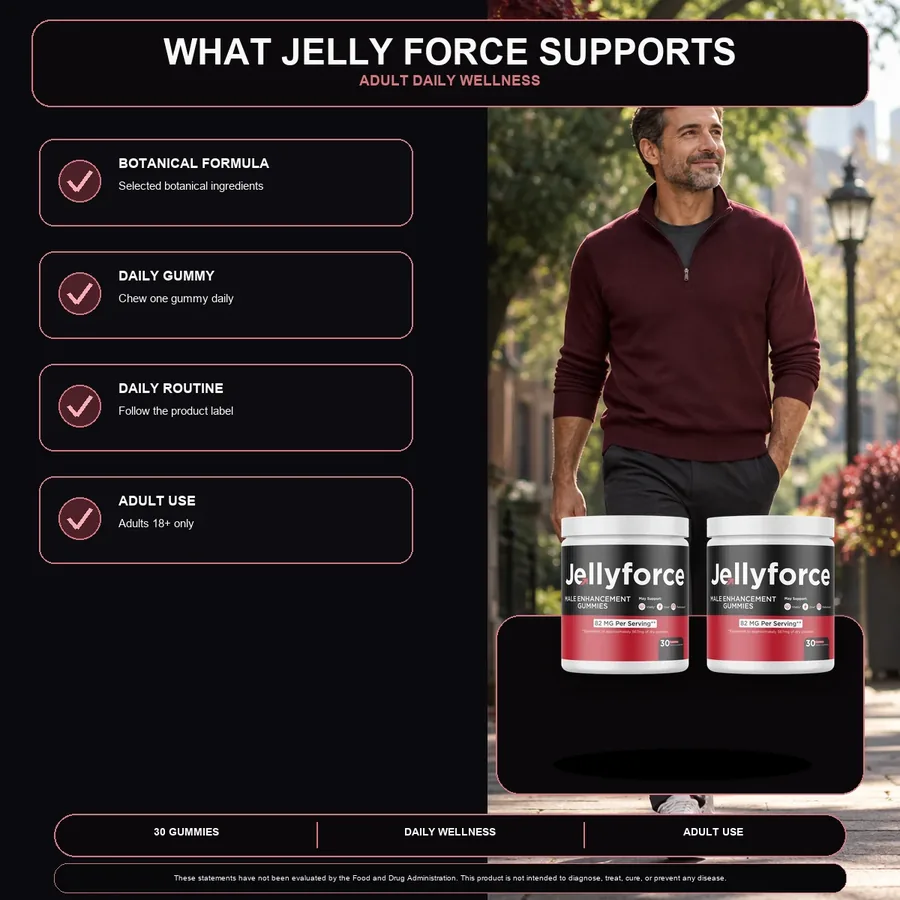
What it settles is real but small: this is a chewable taken once a day, by adults, and the actives are botanical. What it does not do is explain a pathway, name a dose or point to a study. Those three absences are the whole subject of this page.
What actually happens when you chew one
Three things are printed and therefore certain. You swallow 3 grams of added sugar, 10 calories and 4 mg of sodium, and you swallow 5 mg of caffeine, which is roughly a twentieth of a cup of coffee. Then you swallow 82 mg of mixed plant extracts and an amino acid.
Nothing about that should feel dramatic, and if a supplement in this category ever does feel dramatic, that is a reason to stop and read the FDA’s notifications list for this product class. The agency’s own wording is that many products claiming to help with sexual enhancement are likely to be contaminated with undeclared prescription drug ingredients and pose a serious health risk. Nothing in the material we were given suggests this product is one of them. It is a reason to be careful about the aisle, not an accusation about the bottle.
For the honest planning question, how long to give it before deciding, see the timeline page. For who should not take it at all, see who it is for.
How Jelly Force works: common questions
How does Jelly Force work?
No study of the finished gummy has been published, so there is no tested mechanism to describe. The label lists nine ingredients inside an 82 mg blend, and the published research behind them is about single ingredients at amounts this label does not print.
Which ingredient has the best evidence?
L-arginine. A review of common ingredients in this category called it the only one showing reproducible improvement in human trials. Those trials used 2 to 20 grams a day, and the entire blend here is 82 mg.
Is there any clinical trial of this product?
None was supplied and none is published. Every source cited on this site is about an ingredient rather than about this gummy.
Does the caffeine do anything at 5 mg?
Very little. A cup of brewed coffee is roughly 95 mg, so this is about a twentieth of a cup. It is listed because anyone avoiding caffeine deserves to know it is in the bottle.
Does a gummy work differently from a capsule?
It is chewed rather than swallowed whole, and it carries sugar and syrup that a capsule does not. No measurement of how much of the blend is absorbed from this gummy base has been published.
Will it raise testosterone?
Nothing on the label claims that, and the one ingredient here most often sold on a testosterone story is tribulus, which a controlled study in young men found does not influence androgen production.
Should I expect to feel something on day one?
There is nothing on the panel that would be expected to produce a same-day effect. Three grams of sugar and 5 mg of caffeine is the measurable part of a single gummy.
Sources for this page
- Srivatsav A, Balasubramanian A, Pathak UI, et al. Efficacy and Safety of Common Ingredients in Aphrodisiacs Used for Erectile Dysfunction: A Review. Sexual Medicine Reviews, 2020. Source
- Shin BC, Lee MS, Yang EJ, Lim HS, Ernst E. Maca (L. meyenii) for improving sexual function: a systematic review. BMC Complementary and Alternative Medicine, 2010. Source
- LiverTox: Clinical and Research Information on Drug-Induced Liver Injury. Green Tea. National Institute of Diabetes and Digestive and Kidney Diseases. Source
- U.S. Food and Drug Administration. Spilling the Beans: How Much Caffeine is Too Much? Source
- National Center for Complementary and Integrative Health. Ashwagandha: Usefulness and Safety. Source
- NIH Office of Dietary Supplements. Dietary Supplements for Exercise and Athletic Performance: Fact Sheet for Health Professionals. Source
- Neychev VK, Mitev VI. The aphrodisiac herb Tribulus terrestris does not influence the androgen production in young men. Journal of Ethnopharmacology, 2005. Source
- LiverTox: Clinical and Research Information on Drug-Induced Liver Injury. Horny Goat Weed. National Institute of Diabetes and Digestive and Kidney Diseases. Source
- U.S. Food and Drug Administration. Sexual Enhancement and Energy Product Notifications. Source
Keep reading
Ready when you are
Order Jelly Force from the U.S. retail desk
One gummy a day. Follow the label on your bottle. 60-day money-back guarantee. A real person at +1 (302) 200-3480 for orders, tracking and refunds.