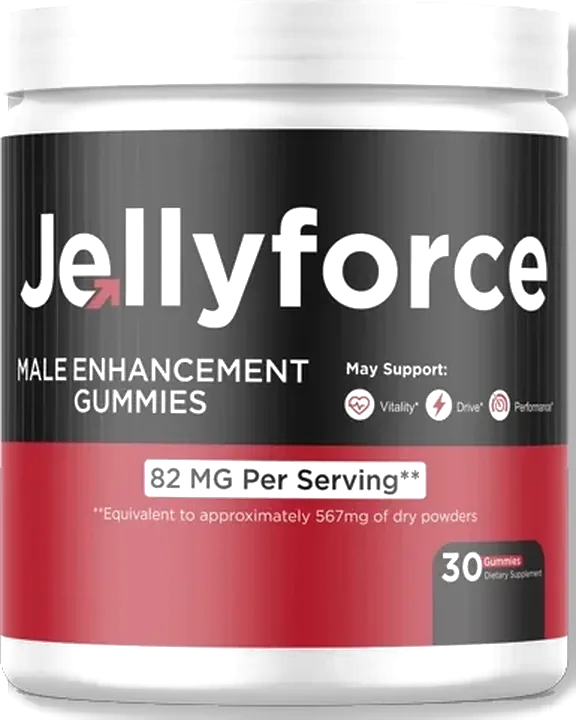
One panel, read from the top down
Jelly Force As A Worked Example: Reading A Gummy Label
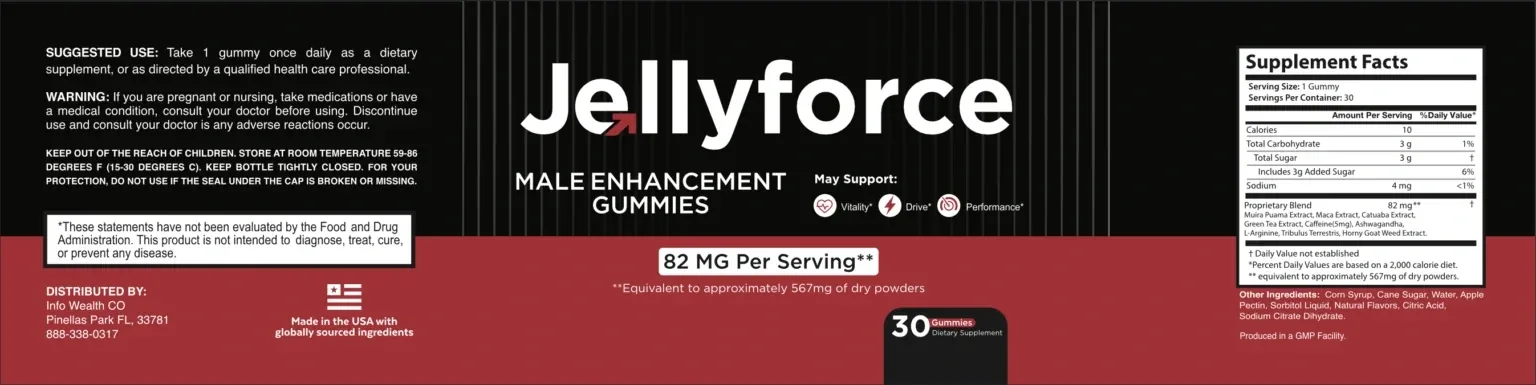
A gummy label has two ingredient lists, not one. The Supplement Facts panel holds the nutrition lines and the active blend, and a separate other-ingredients line holds the candy. On this bottle the panel prints 10 calories, 3 g of total sugar all of it added, 4 mg of sodium and one 82 mg blend of nine names. The gummy itself starts with corn syrup.
Where do you start on a gummy label?
At the serving size, every time. It is the top line of the Supplement Facts panel and it is the unit every other number on the panel is measured in, so reading anything before it means reading it wrong.
Here the serving is 1 gummy and the container holds 30, so one bottle is a month. Plenty of gummies ask for two or three a serving, which quietly doubles or triples every figure underneath. The table below walks the panel on this bottle, one printed line at a time.
| Printed line | What it says on this bottle | What it tells you |
|---|---|---|
| Serving Size | 1 gummy | Every figure below is per one gummy, never per bottle |
| Servings Per Container | 30 | One bottle is 30 days at the printed dose |
| Calories | 10 | Small, and 30 days of it if you take one daily |
| Total Carbohydrate | 3 g (1% DV) | Almost entirely sugar here |
| Total Sugar | 3 g | Carries a dagger: no Daily Value is set for total sugar |
| Includes Added Sugar | 3 g (6% DV) | All of the sugar is added sugar |
| Sodium | 4 mg (under 1% DV) | Trivial on its own |
| Proprietary Blend | 82 mg, dagger | One weight for nine ingredients, with no Daily Value established |
The panel is typed out in full on the Supplement Facts page.
How much sugar is in a daily gummy, and does it matter?
On this label, 3 grams a gummy, all of it added sugar. That is 6 percent of the Daily Value, printed in the right-hand column.
Added sugar is sugar put in during processing, as against the sugar that comes with fruit or milk. The FDA requires it on its own line so a buyer can see it separately (FDA on added sugars). Here the total sugar and added sugar lines carry the same figure, so there is no fruit sugar in the gummy worth counting.
Whether 6 percent a day matters is your call and your doctor’s. Put it next to the active side of the same panel: the blend weighs 82 mg, the added sugar 3,000 mg. Our post on what 82 mg buys you draws both on one scale.
What is the difference between the Supplement Facts panel and the other-ingredients line?
The panel holds what the product is sold for. The other-ingredients line holds what it is made of. On a gummy, that second list is most of the weight in your hand.
Here is the printed line: Corn Syrup, Cane Sugar, Water, Apple Pectin, Sorbitol Liquid, Natural Flavors, Citric Acid, Sodium Citrate Dihydrate. That order is by weight too. Corn syrup is first and cane sugar second, which is where the 3 grams comes from. Then water, then apple pectin as the gelling agent, then sorbitol liquid, a sugar alcohol, then the flavors and acids.
- The panel is where amounts and Daily Values appear
- The other-ingredients line has no amounts, only an order
- Allergens, gelling agents and sweeteners live on that second line
- On a gummy it is the larger part of the serving by weight
One practical note. Sugar alcohols such as sorbitol give some people wind or loose stools. The side effects page covers it properly.
What does a 82 mg blend total tell you, and what does it not?
It gives you a ceiling and an order. It does not give you a dose, and it cannot be divided into one.
The bargain in a blend line
A proprietary blend line is a bargain struck in the labeling rules. The maker publishes one total weight and the full list of names under it, heaviest first, and keeps every individual amount to itself (FDA labeling guide). It is legal, it is everywhere in this aisle, and it is the main reason a label can be read carefully and still not answer your question.
On this bottle the line reads Proprietary Blend 82 mg, with nine names under it: Muira Puama Extract, Maca Extract, Catuaba Extract, Green Tea Extract, caffeine at 5 mg, Ashwagandha, L-Arginine, Tribulus Terrestris and horny goat weed extract. So what does the total actually tell you? It sets a hard ceiling. No ingredient in that list can weigh more than 82 mg, and because the names run heaviest first, everything after the caffeine must weigh 5 mg or less.
What it does not tell you is any single amount. Dividing 82 by nine gives about 9 mg each, and that number is fiction, because blend parts are not equal shares. The first name could be most of the total, or a third of it. The panel does not say, and a reader who guesses has stopped reading the label and started writing it.
One name is broken out, which is a courtesy rather than a loophole. Caffeine is printed as 5 mg inside the blend. A maker may give an individual figure that way, and this one did it for exactly one of nine ingredients. Where a figure appears, use it. Where it does not, say not published.
All nine names, with what is known about each, are on the ingredients page.
Pectin or gelatin: does a vegetarian claim on a gummy hold up?
Read the gelling agent. That one word settles the vegetarian question faster than any seal.
Most gummies set with gelatin, made from animal collagen. Some set with pectin, which comes from fruit. This label prints apple pectin and no gelatin anywhere, so the vegetarian seal on the listing is doing better than a seal usually does. That is worth saying plainly.
The support is partial. “Natural flavors” sits on the same line and is an undefined term, so nobody reading the label can tell what is in it. A vegetarian who needs certainty has to ask the maker, and the testing and quality page lists what an answer would have to contain.
Why does the word natural not settle anything?
Because it has no fixed legal meaning on a supplement label. It is a marketing word, and two products using it can be made of different things.
That matters here because a seal on the sales page reads “100% NATURAL INGREDIENTS”, and the printed line includes corn syrup, cane sugar, sorbitol liquid, citric acid and sodium citrate dihydrate. None of those is unusual in a gummy, and none is what most people picture when they read that seal. The label wins, and the claims page stamps it against the panel.
The test for any word on the front of a bottle is the same. Find the printed line that would have to support it and read that line. Words with legal definitions, such as added sugar, behave differently: they mean one thing on every label in the country.
The footnotes, which is where the label tells on itself
Three footnotes sit under this panel and each changes how a line above it reads. They are the smallest type on the bottle and the most honest part of it.
The first is “Daily Value not established”, attached to the blend, meaning no official reference amount exists so no percentage can be printed. The second is that percent Daily Values are based on a 2,000 calorie diet. The third is the interesting one: “equivalent to approximately 567 mg of dry powders.”
That third footnote is the maker being fair. It says 82 mg of concentrated extract stands in for roughly 567 mg of the raw dried plant it came from. Both numbers are honest and they measure different things, so quote the 567 mg whenever you quote the 82 mg. Then remember 567 mg is still well under a gram, and the L-arginine trials in this category run 2 to 20 grams a day (NIH ODS).
Under the footnotes, one more printed line: “Produced in a GMP Facility.” Five words, no certificate number, no auditor, no date.
Reading a gummy label: common questions
What is the first thing to read on a gummy label?
The serving size, then the servings per container. Every other number is per serving. Here the serving is 1 gummy and the container holds 30.
How much added sugar is in one of these gummies?
Three grams, which the panel gives as 6 percent of the Daily Value. Total sugar and added sugar carry the same figure, so all of it was put there during manufacture.
Why do the blend ingredients have no amounts?
Because they sit inside a proprietary blend, which publishes one total and the names in order of weight rather than a figure for each. Here the total is 82 mg and only caffeine has its own figure, at 5 mg.
Can I work out how much of each ingredient is in the 82 mg?
No, and dividing by nine gives a number that is not real. Blend parts are not equal shares. The order tells you which names weigh more than which, and that is the whole of what it tells you.
Is this gummy suitable for vegetarians?
The gelling agent is apple pectin rather than gelatin, and no gelatin appears on the printed line. The natural flavors entry on the same line is undefined, so the support is partial.
What does the 567 mg footnote on the bottle mean?
That the 82 mg of extract is described as equivalent to roughly 567 mg of dry plant powders. It is the fairer figure for the blend's size, and still well under a gram.
Does 100% natural mean anything on a label?
No. The word has no fixed legal meaning on a supplement label. Read the printed other-ingredients line instead.
Sources for this page
- U.S. Food and Drug Administration. Added Sugars on the Nutrition Facts Label. Source
- U.S. Food and Drug Administration. Dietary Supplement Labeling Guide: Chapter IV. Nutrition Labeling. Source
- NIH Office of Dietary Supplements. Dietary Supplements for Exercise and Athletic Performance: Fact Sheet for Health Professionals. Source
Keep reading
Ready when you are
Order Jelly Force from the U.S. retail desk
One gummy a day. Follow the label on your bottle. 60-day money-back guarantee. A real person at +1 (302) 200-3480 for orders, tracking and refunds.