Four numbers, one panel
What 82 mg Buys You On The Jelly Force Panel
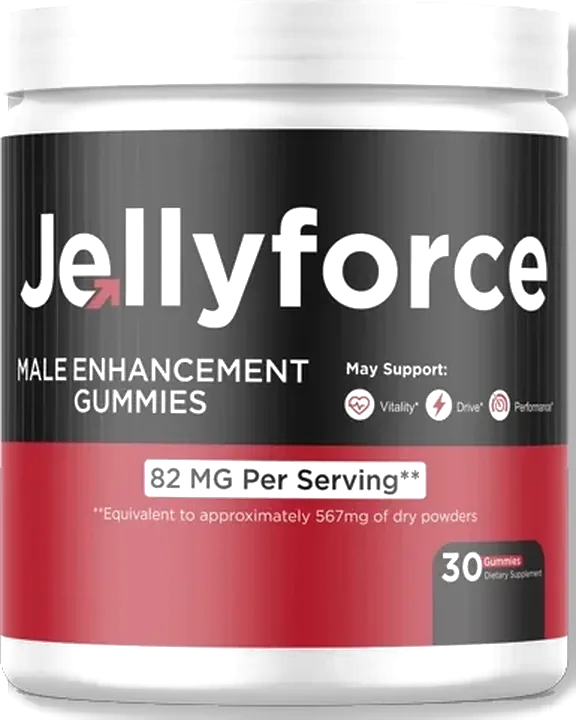
82 milligrams is the whole proprietary blend in one Jelly Force gummy, shared by nine ingredients. The same gummy carries 3 g of added sugar, which is 3,000 mg. The L-arginine trials in this category use 2 to 20 grams a day. A cup of coffee holds about 95 mg of caffeine. All four numbers are printed or published, and none of them is an opinion.
What is 82 milligrams?
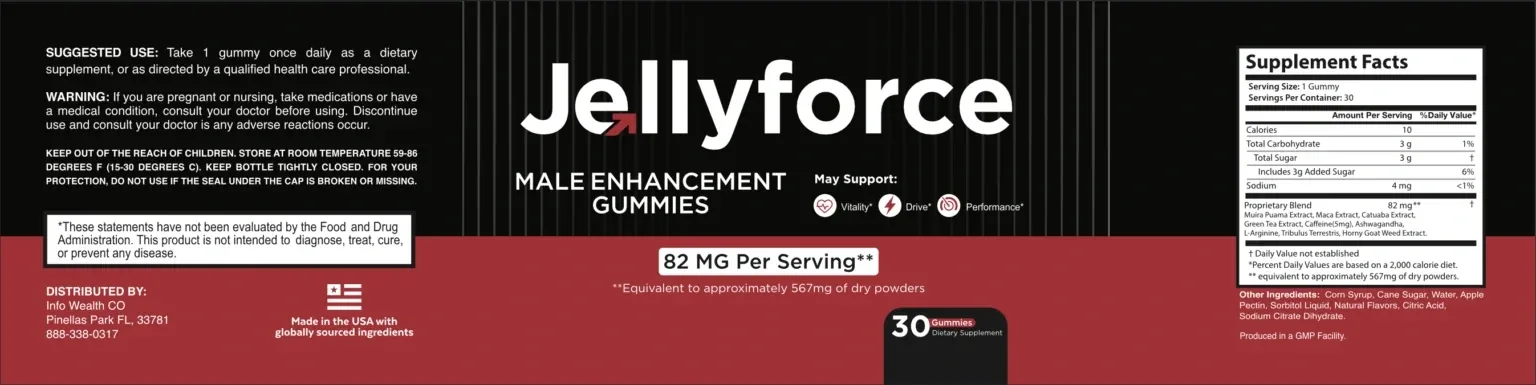
It is the total printed weight of the Proprietary Blend line on the Jelly Force Supplement Facts panel. Nine named ingredients share it, and only one of the nine, caffeine at 5 mg, has a figure of its own.
A milligram is a thousandth of a gram, so 82 mg is a little under a tenth of a gram. A US nickel weighs 5 grams, which makes the blend about a sixtieth of a nickel. That is not a criticism. Plenty of useful substances work at milligram weights. It means the number needs company before it means anything.
So here is its company: four numbers, each of them printed on this bottle or published by a federal health source.
| Number | What it is | Where it comes from |
|---|---|---|
| 82 mg | The whole blend, nine ingredients | Printed on the Supplement Facts panel |
| 567 mg | What the label calls the dry-powder equivalent of that blend | Printed panel footnote |
| 3,000 mg | The added sugar in the same gummy, which is 3 g | Printed on the same panel, 6% of the Daily Value |
| 2,000 to 20,000 mg | Daily L-arginine doses used in the performance research | NIH ODS |
| 95 mg | Caffeine in a cup of brewed coffee | FDA |
The sugar and the blend are on the same panel
This is the comparison to start with, because both numbers were printed by the same maker on the same label and neither needs interpreting. The added sugar in one gummy weighs about 37 times what the entire active blend weighs.
One gummy, by printed weightboth bars on one scale
- Added sugar3 g · 3,000 mg
- Proprietary blend, all nine ingredients82 mg
Both bars are drawn to one scale from printed figures: 3 g of added sugar, which is 3,000 mg, against the 82 mg Proprietary Blend holding all nine ingredients. Nothing is estimated.
Read that carefully rather than angrily. Three grams of sugar is not much sugar. It is less than a teaspoon, 6 percent of the Daily Value, and it is there because a gummy has to taste like a sweet or nobody chews it (FDA on added sugars). Corn syrup and cane sugar are the first two entries on the other-ingredients line for that reason.
The point of the picture is proportion. In a daily gummy, most of what you put in your mouth is the delivery system rather than the thing delivered. That is true of every gummy on the shelf, and worth seeing once, drawn to scale.
82 mg against the trials that use grams
One ingredient in this bottle has the strongest human evidence in the whole category, and that ingredient is the one where the arithmetic gets uncomfortable. L-arginine is seventh of nine in the printed order.
A review of ingredients common in this category found the evidence for most of them inadequate and named L-arginine as the only one showing reproducible improvement in erectile function across human trials (Srivatsav et al., 2020). That is a real finding, said clearly. The amounts are the problem: NIH’s Office of Dietary Supplements notes 2 to 20 grams a day in that research (NIH ODS).
- Studied range, low end2,000 mgPer day, from the published research
- Studied range, high end20,000 mgPer day, same source
- Whole blend, nine ingredients82 mgPrinted total, one gummy
- Blend as dry powders567 mgThe label's own equivalence footnote
The arginine in one gummy is some unpublished share of 82 mg. It sits below the caffeine in the printed order, so it cannot exceed 5 mg. Against a low-end studied dose of 2,000 mg, that is at most a four-hundredth. This is not a claim that the product does nothing. It says no amount here can be compared with the research, because the amount is not published and is capped well below it.
The caffeine number, and why it is the honest one
Caffeine at 5 mg is the only individual figure on the blend line. It is also the one number anyone can put in scale without help.
The FDA points to 400 mg a day as the amount not generally tied to problems in healthy adults, and gives a cup of brewed coffee as roughly 95 mg (FDA). So 5 mg is about a twentieth of a cup, and nobody feels that. If you avoid caffeine, the reason to know is not the effect. It is that the sales page does not mention it. The green tea extract listed above it is a second caffeine source with no figure at all.
What the 567 mg footnote means, fairly
The panel does not leave 82 mg standing on its own. A footnote on the same label reads: “equivalent to approximately 567 mg of dry powders.” That footnote should be quoted every time the 82 mg is, because it is the maker giving you the fairer figure.
Here is what it says. An extract is a concentrate: you start with dried plant, pull the soluble parts out, and boil off the rest. What is left weighs less but carries much of what was in it. So 82 mg of extract can reasonably stand in for roughly 567 mg of raw dried plant, close to a seven-fold concentration.
Two things follow and both are true at once. The blend is bigger than 82 mg makes it sound, so quoting 567 mg is fairer. And 567 mg is still well under a gram, so it changes nothing about the arginine comparison above. What the footnote does not give is a ratio per ingredient, which is the figure that would let anyone check the equivalence. The word approximately is the maker’s.
So what do you do with these numbers?
Use them to set your expectations before you spend, and to compare bottles rather than brands. Three habits do most of the work.
Read the blend total before the ingredient names
The names are the part the marketing prepared you for. The total is the part that limits what the names can be doing.
Put the total next to a studied dose, once
For this category that means grams of L-arginine. If a blend total is a fraction of a gram, no ingredient inside it reaches the research, and you can stop wondering.
Weigh the delivery system too
Three grams of added sugar a day, 30 days a bottle, is part of what you buy. It is 6 percent of the Daily Value per gummy.
Then decide with your eyes open. Nothing in this arithmetic says the gummy is harmful or the plants are worthless. It says the published amounts do not support a promise, which is why the honest version of this product is a habit somebody chooses rather than a result somebody expects. The ingredients page has all nine names.
And if the reason you are reading this is erection trouble, the better first move is a doctor’s appointment. NIDDK lists heart and blood vessel disease, diabetes, kidney disease, obesity, hormone problems, nerve damage, several common medicines and stress among the causes, and says the difficulty can be a symptom of another health problem (NIDDK).
82 mg: common questions
How much of each ingredient is in 82 mg?
Not published, except caffeine at 5 mg. A proprietary blend gives one total and lists its parts heaviest first, so the order is known and the amounts are not. Dividing 82 by nine produces a number that is not on the label and is not true.
Is 82 mg a small dose?
It is a small weight. Whether it is a small dose depends on the ingredient, and for the one ingredient here with the strongest human evidence, L-arginine, the published research uses 2 to 20 grams a day. 82 mg is a fraction of the low end of that.
Why compare a supplement blend with sugar?
Because both figures are printed on the same panel by the same maker, so the comparison needs no assumptions.
Is 3 grams of added sugar a lot?
No, taken on its own. It is 6 percent of the Daily Value and less than a teaspoon. It matters because it repeats every day you take the product, and because anyone counting sugar for a medical reason should hear it from a label.
Does the 567 mg footnote mean there is more in the gummy than 82 mg?
No. The gummy contains 82 mg of blend. The footnote says that weight of extract is equivalent to roughly 567 mg of dry plant powders, which is a statement about concentration rather than about how much is in your mouth.
Does the caffeine in this gummy matter?
At 5 mg, roughly a twentieth of a cup of coffee, most people will not feel it. It matters because a man avoiding stimulants deserves to see it listed, and the sales page does not name it.
Where can I see the whole Jelly Force panel?
On the Supplement Facts page, typed line for line from the printed label.
Sources for this page
- NIH Office of Dietary Supplements. Dietary Supplements for Exercise and Athletic Performance: Fact Sheet for Health Professionals. Source
- Srivatsav A, Balasubramanian A, Pathak UI, et al. Efficacy and Safety of Common Ingredients in Aphrodisiacs Used for Erectile Dysfunction: A Review. Sexual Medicine Reviews, 2020. Source
- U.S. Food and Drug Administration. Added Sugars on the Nutrition Facts Label. Source
- U.S. Food and Drug Administration. Spilling the Beans: How Much Caffeine is Too Much? Source
- National Institute of Diabetes and Digestive and Kidney Diseases. Symptoms & Causes of Erectile Dysfunction. Source
Keep reading
Ready when you are
Order Jelly Force from the U.S. retail desk
One gummy a day. Follow the label on your bottle. 60-day money-back guarantee. A real person at +1 (302) 200-3480 for orders, tracking and refunds.